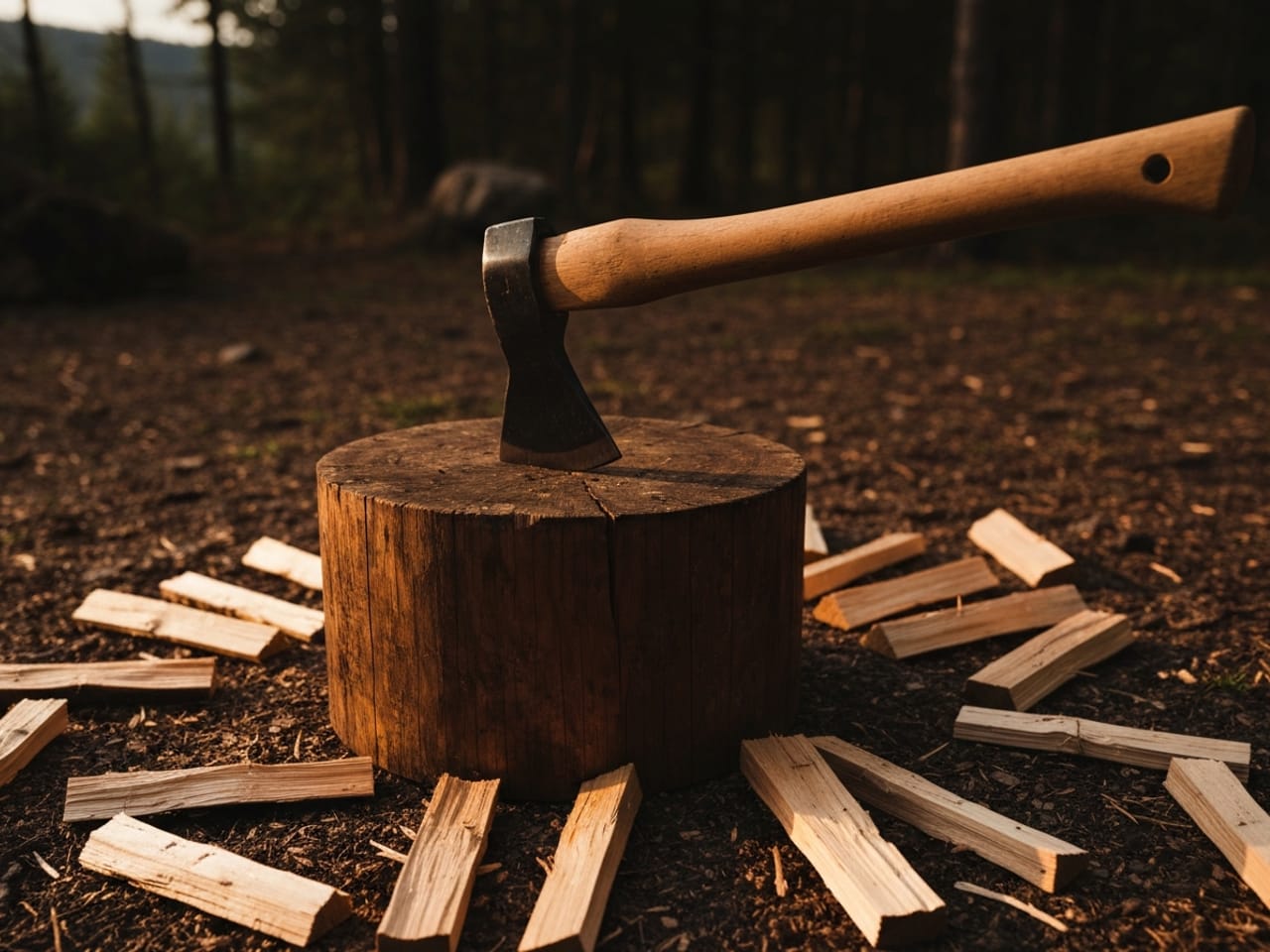
A budget axe is not a worse version of an expensive axe. It is the same job done with less refinement. Under fifty dollars you pay for a decent head and a serviceable handle, and you supply the rest yourself with a stone and ten minutes of attention. Every axe below chops wood. The question is what corners the maker cut to hit the price, and whether those corners matter for how you will use it.
Who this guide is for
Anyone who wants a working axe without spending a week's grocery money on it. That covers first-time buyers, people who want a beater to leave in the truck or the canoe, and anyone who would rather learn to sharpen on a forty-dollar axe than a two-hundred-dollar one. If you have decided you want the best axe you can buy and price is not the deciding factor, read the full bushcraft axe guide instead, which covers premium options like the Gransfors Bruks Small Forest Axe. If you specifically want a compact hatchet under 14 inches, see the best hatchet guide.
What to look for under $50
Where the money went, and did not
At this price the head is usually forged fine. What you give up is the finish work: the edge comes thick and rough, the handle grain is whatever came off the rack, and the hang may need a wedge tapped home. None of that stops the axe from working. It just means the first hour is on you. What you do not give up is capability. A profiled Husqvarna will out-chop most axes twice its price straight out of the box.
Handle length and material
13 to 15 inches suits one-handed work and belt carry. Around 19 inches is more versatile for camp. Hickory is the standard and can be replaced when it breaks. A composite handle like the Fiskars will never crack or swell, but you cannot re-hang it, so a cracked head ends that axe. A one-piece steel axe like the Estwing removes the handle question entirely at the cost of more shock in the hand.
Steel and edge
High carbon steel (Swedish, 1055) sharpens easily on a cheap stone and holds up under hard use. Expect the factory grind to be too obtuse for clean chopping. Thinning it behind the edge is the single change that turns a budget axe from a wedge into a cutter. That is a file and a stone, not a workshop.
In the field: all five axes
Husqvarna 13-inch Hatchet (~$40)
Swedish carbon steel head, 1.3 lb, on a 15-inch curved hickory handle, leather edge guard included. The head is drop-forged by Hults Bruk, so you are getting real axe-making for the money. The catch is the factory edge: thick and dull, it needs a stone before it will bite. Spend the twenty minutes and it works well above forty dollars. This is the honest budget starting point for bushcraft axe work.
Fiskars X7 Hatchet, 14 inch (~$30)
Forged carbon steel head, hardened to about 50 to 56 HRC, insert-molded into a FiberComp handle you cannot break through normal use. 1.25 lb, 14 inches, good factory edge, plastic sheath included. Zero maintenance. It will not crack, swell, or split, and the low-friction coating helps it release from wood. The one limit is that a cracked head cannot be re-hung. The practical choice if you want a hatchet you never think about.
Estwing Sportsman's Axe E24A (~$45)
One-piece 1055 steel forged from head to grip, 13.5 inches overall, 1.3 lb head, stacked leather washer handle. Nothing on it can come loose or split, which is the whole point. The trade is shock: a solid steel axe transmits more of every strike into your hand than a wood-handled one, so it is tiring over a long session. The factory edge, like most, wants thinning. Buy it if durability outranks comfort.
Cold Steel Trail Boss (~$40)
Drop-forged 1055 carbon steel head at 1 lb 13 oz, on a 27-inch American hickory handle. This is the one full-reach chopper on the list. The long handle and heavier head move real wood per swing, so it processes firewood faster than any hatchet here, at the cost of being too big to carry on your belt. The head is often hung and finished roughly, so check the wedge and thin the edge. A lot of axe for the money if you want reach.
Truper 1.25 lb Camp Axe, 14 inch (~$25)
Forged steel head, 1.25 lb, on a 14-inch hickory handle. This is the rock-bottom option, the axe you buy to learn on or to lose. Fit and finish are basic: expect a dull edge, a plain hang, and a handle you may want to sand smooth. But the head is forged, not cast, so with a file and a stone it becomes a usable camp hatchet for the price of lunch. Nobody's forever axe, and that is fine.
How to choose
- Want the most axe for forty dollars and do not mind sharpening: Husqvarna 13-inch.
- Want a hatchet you never maintain or worry about: Fiskars X7.
- Want something that physically cannot come apart: Estwing E24A, if you accept the hand shock.
- Want reach and firewood speed over pack size: Cold Steel Trail Boss.
- Want the cheapest thing that still works, to learn on: Truper camp axe.
- Whatever you pick, budget the first twenty minutes for the edge. That step, not the badge, is what separates a cheap axe that works from one that bounces.
A budget axe is not a cheap tool. It is a good head and a plain handle with the finishing work left for you to do. Do it, and the gap to a two-hundred-dollar axe is smaller than the price suggests.
Should you buy it?
For most people the Husqvarna 13-inch is the budget pick: real steel, real hickory, about forty dollars, and it rewards the sharpening. If you never want to touch a stone, the Fiskars X7 is the honest answer. Need reach for firewood, take the Trail Boss. Want the cheapest working axe to learn on, the Truper does it for twenty-five dollars. And if you find yourself wanting to spend more for fit and finish that lasts a lifetime, that is your cue to read the full axe guide. This is the same split we use on the knife side, where the best budget bushcraft knife guide sits alongside the premium roundup. Before you swing any of these, it helps to know how to baton wood and process it safely.
See more in axes and hatchets.
Affiliate disclosure: Some links in this guide are affiliate links. If you buy through them we may earn a small commission, at no extra cost to you. It does not influence which products we recommend. Read our methodology.